

The Popularity and Application of RFID Tags Lead the Wave of Digital Economy
Date: 2026-03-26
The Popularity and Application of RFID Tags Lead the Wave of Digital Economy
With the deepening of the Fourth Industrial Revolution, more and more traditional industries have started to embrace the digital era. In this process, the emergence and popularity of RFID tag technology have provided feasible solutions for the digital transformation of the following five industries: retail, logistics, medical, asset management, and hotel service industry.
In the retail industry, RFID tags have gradually replaced traditional barcode technology. Through RFID technology, the information of goods can be recorded in the system in real-time, greatly improving the accuracy of information and the efficiency of data management. Meanwhile, customers can simply view detailed product information by performing a simple operation, without having to flip the item or scan the barcode. It is foreseeable that the application of RFID tag technology in the future retail industry will bring greater revolutionary changes.In the logistics industry, RFID technology has a wider range of applications. For example, in parcel transportation, RFID tags can record the geographic information of goods, enabling logistics companies to more accurately track the transportation status of parcels. In addition, RFID tags can also share multi-source data through the Internet of Things technology, quickly transmitting information from various nodes of the logistics industry to the information system, greatly improving the efficiency of the entire logistics process.
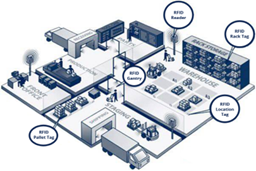
For the medical industry, strict and orderly management of equipment and supplies is required, and RFID technology can help medical institutions complete this work. After using RFID tags, medical institutions can achieve real-time item tracking, thereby quickly finding the necessary equipment or supplies. In addition, RFID technology can also improve the identification rate of patient identity, thereby improving medical services and reducing the rate of medical disputes.

In terms of asset management, RFID tags can achieve precise management. By attaching RFID tags to equipment, vehicles, and other items, it can easily achieve the supervision, management, and tracking of materials. RFID tag management can effectively prevent the harm of items being artificially damaged or lost, as well as the risk of stolen items.
In hotel services, RFID tags are also a very useful tool. After the traveler arrives at the hotel, RFID tags can embed information into their accommodation card. The hotel can use the use of RFID tag technology to improve customer service to a certain extent. The hotel information system can easily track and manage room status, quickly respond to room service needs, and provide more efficient services. At the same time, hotels can also use RFID technology to improve room security and protect customer privacy.
Overall, RFID tag technology has wide and in-depth applications in various industries, injecting new vitality into the digital transformation of industries. As RFID technology continues to develop and improve, it will also demonstrate more lasting and distinctive advantages in a broader range of application scenarios in the future. This wave of digital economy is constantly impacting various industries, enabling us to see a smarter and more efficient future.