

RFID Tag Play an Important Role in Retail Scenarios
Date: 2026-03-26
RFID Tag Play an Important Role in Retail Scenarios
Clothing stores
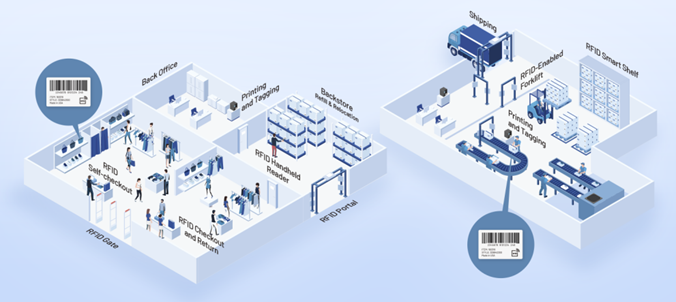
RFID tag can be used for inventory management and sales analysis in clothing stores. By attaching an RFID tag to each garment, the inventory situation can be tracked in real-time, avoiding excessive or insufficient inventory. Furthermore, RFID technology enables employees to complete inventory checks in minutes.
At the same time, RFID tags can assist in tracking product sales and analyzing customer behavior and preferences. As a result, product lines can be optimized according to the needs of customers and marketing strategies such as event planning can be tailored.
Supermarkets
RFID tags can help automate checkout and prevent product loss. By using an RFID reader, all purchased products can be identified and automatically calculated, greatly reducing the workload of customers and cashiers while also improving accuracy.
In addition, the lost alarm feature of the RFID tag can help prevent product theft or misplacement, ensuring product safety and operational efficiency.
Unmanned convenience stores
RFID tags can help achieve automatic product replenishment and accurate checkout. By attaching an RFID tag to each product, the system can monitor inventory in real-time and automatically place orders with suppliers when inventory levels are low.
During checkout, RFID technology can quickly and accurately read product information, eliminating the risk of errors from manual data entry and improving accuracy and efficiency.

Supply chain
RFID tags can assist in logistics tracking and management. By attaching an RFID tag to the packaging of goods, the location and status of the goods can be monitored in real-time throughout the entire delivery process. As a result, any anomalies can be detected and handled in a timely manner, improving the transparency and efficiency of the entire supply chain.

In conclusion, RFID tags play an essential role in various retail scenarios, improving inventory management accuracy, reducing the likelihood of errors, improving work efficiency, and enhancing customer service quality.